

In this guide
- What Are Synthetic Users?
- How Synthetic User Simulation Works
- Synthetic Users vs. Real Participants
- Research Methods With Synthetic Users
- Synthetic User Validity, Bias & Limitations
- How to Use Synthetic Users Responsibly
A note from building Synthers AI
When we started building Synthers AI, I initially thought the hardest part would be making an AI persona sound more like a real person. After working with synthetic users, I think the harder problem is making the simulation useful rather than merely convincing.
The interesting shift happened when we moved from asking synthetic users what they thought to putting them into actual product flows. Instead of asking, “Would you like this feature?”, we can give a persona a goal and let it try to accomplish something. That is where hesitation, unexpected navigation choices, dead ends, and other forms of friction become visible.
That experience shapes how we think about synthetic users throughout this guide. At the current stage, I see a lot of value in simulations making the user perspective available much earlier and more frequently throughout product development, while complementing research with real users. And it will be fascinating to see how far the ability to simulate real human behavior can evolve from here.
What Are Synthetic Users?
A synthetic user is an AI-generated representation of a target user that can simulate responses, decisions, preferences, and behavior within a defined research context.
The simplest way to think about the difference is:
A traditional persona describes a user. A synthetic user simulates one.
A persona might describe a 34-year-old customer who is price-sensitive, unfamiliar with a product category, and primarily uses mobile devices. A synthetic user takes those characteristics and uses them to respond to questions, evaluate concepts, or interact with a product.
The terminology is still evolving. You may encounter terms such as AI personas, synthetic respondents, synthetic participants, user simulations, or generative agents. These terms overlap, but they are not always used to describe exactly the same thing.
| Term | Typical meaning |
|---|---|
| Persona | A structured description of a target user |
| AI persona | A persona represented or generated by an AI model |
| Synthetic respondent | An AI-generated respondent used to answer research questions |
| Synthetic user | An AI representation that can simulate user responses or behavior |
| User simulation | The broader process of modeling how a user may behave |
There is not yet one universally accepted definition of "synthetic user." The field spans several related approaches, from simulated survey respondents to AI agents that interact with environments.
One early and influential line of research explored whether language models could be used to simulate human samples. Argyle et al.'s work showed how language models could generate responses representing different demographic and attitudinal profiles, opening up a broader discussion about synthetic populations in social research.
But synthetic users are not simply chatbots with different personalities.
A chatbot answers a question. A synthetic user is intended to represent a defined perspective, with particular goals, experience, constraints, motivations, or preferences.
That difference becomes much more useful when the simulation moves from opinions to behavior.
Instead of asking:
Would this user like the feature?
you can give the simulated user a goal and observe what happens when it encounters an interface.
What does it click? What information does it look for? Does it understand what to do next? Does it hesitate between two options? Does it reach the intended outcome?
At that point, synthetic users start to overlap with usability testing and behavioral simulation.
They are still simulations, however. A synthetic user's response is not a statement from a real customer, and simulated behavior is not automatically evidence of how a real population behaves.
That distinction should remain in view throughout any synthetic research project.
How Synthetic User Simulation Works
A useful synthetic user simulation has more moving parts than a persona prompt.
At a conceptual level:
Participant profile + grounding + context + task + constraints + language model → simulated behavior
The participant profile describes who the simulated user is. It might include experience, goals, motivations, preferences, prior knowledge, or constraints.
Grounding provides the evidence and assumptions behind that representation. Depending on the use case, it can come from existing personas, interviews, surveys, customer feedback, behavioral data, or other research.
Context describes the situation in which the user is making a decision. Someone evaluating a pricing page before purchasing is in a different situation from someone casually browsing a product for the first time.
The task defines what the user is trying to accomplish.
The model then uses these inputs to generate responses or actions.
The simulation loop
For interactive UX research, the process can be thought of as a loop:
Persona → Goal → Context → Observe → Act → Interface Response → Interpret → Next Action
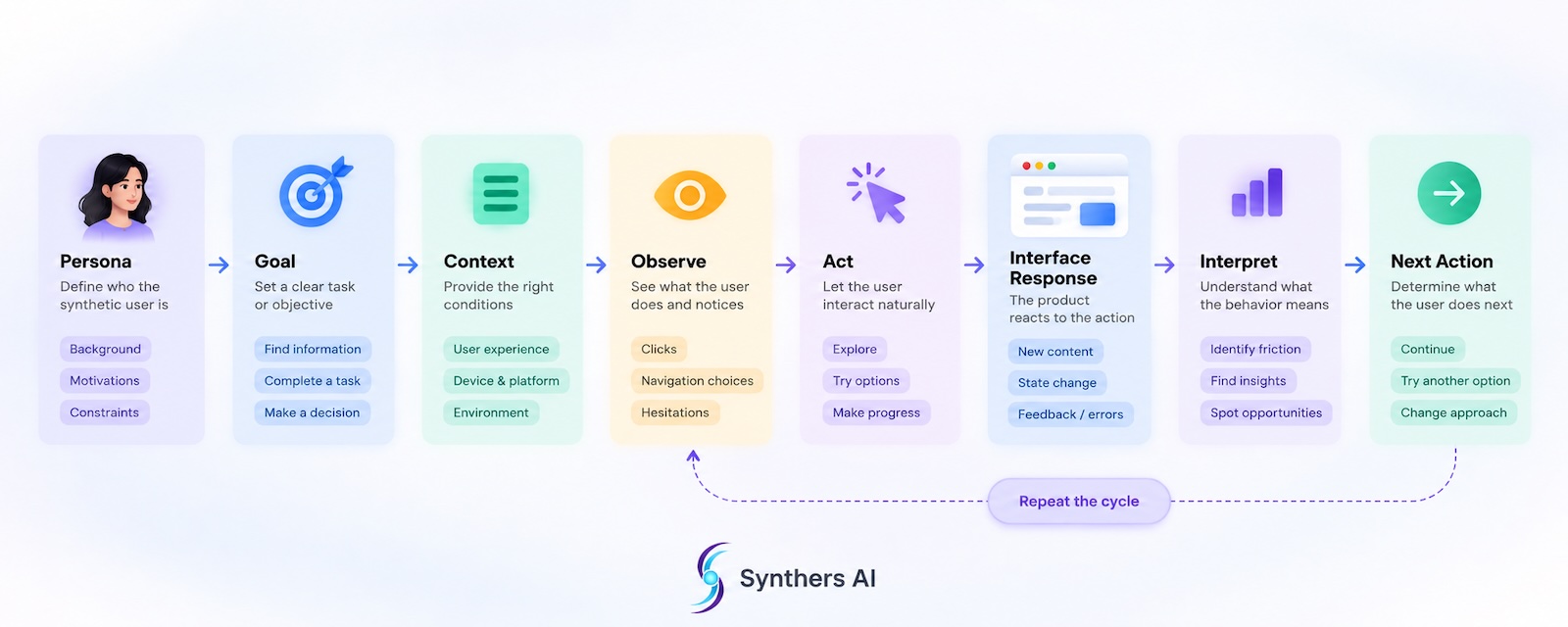
The important part is the loop.
The user does something. The interface responds. The simulated user interprets what happened and decides what to do next.
That creates a different research object from a single generated answer.
For example, imagine a first-time customer trying to find a product, understand its pricing, and complete signup.
Example: A price-sensitive first-time buyer lands on a SaaS pricing page. They understand the product but cannot tell which plan applies to them. Instead of immediately choosing the cheapest option, the simulated user returns to the feature comparison, searches for usage limits, and eventually abandons the signup.
A simulation might therefore expose a sequence such as:
- Land on the page
- Look for information about the product
- Compare available plans
- Search for missing information about usage limits
- Return to the feature comparison
- Hesitate over the choice
- Attempt to continue
- Abandon when the next step remains unclear
The resulting journey can reveal things that a question-and-answer interaction may never expose.
Research on generative agents demonstrated an early version of this broader approach. Park et al. showed how LLM-based agents could combine observation, planning, memory, and reflection to generate believable behavior in an interactive environment.
For UX research, the environment can be considerably simpler than the simulated world in that research. It might be a website, prototype, onboarding flow, checkout process, pricing page, or product interface.
Another important component is variation.
If ten synthetic users receive essentially the same assumptions and produce the same reasoning, the apparent sample size can be misleading. Useful simulations need meaningful differences in how participants interpret information, prioritize goals, tolerate friction, and respond to uncertainty.
And this is one of the reasons synthetic user research cannot be reduced to making an AI persona "sound human."
A believable personality is only one part of the system. The quality of the simulation depends on the representation of the user, the grounding behind it, the task, the environment, the model, and the way the simulation is evaluated.
Synthetic Users vs. Real Participants
Synthetic users and real participants can occupy different places in the same research process.
Synthetic users make it possible to explore many situations quickly and repeatedly. You can create different user profiles, run the same scenario under different assumptions, compare reactions, and investigate potential problems before recruiting participants.
Real participants provide something fundamentally different: evidence from people who actually belong to the population being studied.
They bring lived experience, personal context, unexpected interpretations, workarounds, habits, constraints, and needs that may not be represented in a model.
| Synthetic users | Real participants |
|---|---|
| Fast to create and run | Require recruitment and coordination |
| Easy to repeat | Reflect actual lived experience |
| Useful for exploration | Useful for validating real-world behavior |
| Can test many scenarios | Can reveal unexpected needs and workarounds |
| Useful for generating hypotheses | Provide evidence from the studied population |
| Behavior depends on the simulation | Behavior comes from actual participants |
This makes a hybrid workflow particularly useful.
A team might use synthetic users to explore a new onboarding concept, identify several possible friction points, and decide which questions are worth taking into a real usability study.
The real study can then confirm, reject, or complicate those hypotheses.
Synthetic users → explore possibilities → identify hypotheses → test with real users → compare evidence → refine the product
This approach also changes when user-perspective research can happen.
Instead of treating usability research as something that happens only when a formal study is scheduled, a team can investigate a flow during development, after a significant change, or before a product review.
Synthetic user testing does not remove the need for real participants. It creates another layer of investigation around them.
Research Methods With Synthetic Users
Synthetic users can participate in several kinds of research, but they should not be confused with a research method themselves.
They are simulated participants that can be placed inside different research approaches.
Qualitative research
Language models can simulate open-ended responses, interpretations, expectations, concerns, motivations, and reactions.
For example, a team could present a new product concept to several synthetic user profiles and explore how participants with different backgrounds interpret the value proposition.
This can be useful for generating questions:
- What might this user misunderstand?
- Which part of the concept could create uncertainty?
- What assumptions does the product team appear to be making?
- Which areas deserve further investigation with real participants?
The resulting statements are still generated by a model. They should therefore be treated as exploratory research input or hypotheses rather than customer evidence.
Structured research
Synthetic participants can also be used with more structured research designs, including surveys, rankings, comparisons, and choice tasks.
Here the simulation can help explore how different participant assumptions might affect a research instrument or reveal where a questionnaire itself could create ambiguity.
The same limitation applies: the output depends on how well the simulated participants represent the population relevant to the question.
Synthetic user testing: simulating user journeys
For UX and usability research, one of the most interesting applications is synthetic user testing: putting a synthetic user into an actual product journey and observing what it does.
Instead of asking what the user thinks about an interface, give the user a goal and let it attempt to accomplish that goal.
A journey simulation can reveal where a user:
- Searches for information
- Hesitates between choices
- Misinterprets an interface element
- Takes an unexpected navigation path
- Reaches a dead end
- Loses confidence
- Abandons a goal
- Successfully completes the intended journey
This is one of the areas we have found particularly interesting while building Synthers AI.
The move from "What would this user say?" to "What does this user actually try to do?" changes the kind of signal you can investigate.
It also makes the limitations of simulation easier to see. A model has to commit to a sequence of actions rather than simply producing a plausible explanation after the fact.
Recent research is beginning to evaluate this distinction directly. A 2026 ACL study using 31,865 real online shopping sessions and 230,965 user actions found a substantial gap between believable simulated behavior and accurate reproduction of real user actions.
The implication is important for UX research: a simulation can be useful for exploring possible behavior without necessarily being accurate enough to represent the behavior of the population being studied.
For a deeper look at how bias affects traditional user research, from participant recruitment to analysis, see our guide to User Research Bias: 13 Types and How to Reduce Them.
Synthetic User Validity, Bias & Limitations
The central challenge is validity.
A synthetic user can produce a detailed, coherent and highly convincing response. None of those characteristics establishes that the response is representative of a real person.
Several different sources of uncertainty can enter a simulation.
Model and persona bias
Language models are trained on large collections of human-generated data. Their outputs therefore reflect patterns and assumptions present in that training data.
The persona introduces another layer.
If a target user is represented through a simplistic or stereotypical description, the simulation may amplify those assumptions rather than reproduce the diversity of the real population.
This is particularly important when synthetic users are used to represent groups whose experiences are poorly represented in the source material used to construct the persona.
Prompt sensitivity and sycophancy
The instructions given to a model can influence the behavior it produces.
A prompt that strongly suggests what the user should believe can push the simulation toward the expected answer. Likewise, models can display sycophantic behavior — agreeing with or mirroring the position expressed by the person prompting them.
Sycophancy has been studied as a broader reliability problem in large language models.
For synthetic user research, this means that prompts are not merely technical implementation details. They are part of the research methodology.
A simulation should therefore be tested for sensitivity to wording, assumptions, and other changes that should not materially alter the underlying research question.
Believable behavior is not necessarily accurate behavior
This distinction deserves particular attention.
A synthetic user can produce an answer that sounds exactly like something a real customer might say.
That does not establish that a real customer would say it.
The same applies to actions. A simulated user might navigate a website in a coherent way while following behavioral patterns that do not correspond to the population being studied.
The 2026 ACL research mentioned above provides a useful example. Models produced plausible behavior, but the study found a significant gap when simulated behavior was evaluated against actual next actions in a large real-world shopping dataset.
This is why "it looks realistic" is not enough as an evaluation criterion.
For a deeper look at the latest evidence, see our research review: Synthetic User Bias: What 2025–2026 Research Shows.
Different kinds of validity
There is no single synthetic-user accuracy score that answers every research question.
Depending on what you are trying to learn, several forms of validity may matter:
- Construct validity: Does the simulation represent the intended user characteristics?
- Behavioral validity: Does the simulated behavior resemble relevant real behavior?
- Ecological validity: Does it behave appropriately in the actual context or environment?
- Predictive validity: Can simulation results anticipate later observations?
- Diversity: Does the set of simulations represent meaningful differences between users?
- Stability: Do results remain reasonably consistent when prompts, models, or conditions change?
These dimensions do not have to be perfect for a simulation to be useful.
A lightweight simulation can still be valuable for identifying questions, exploring possibilities, or finding obvious friction. The appropriate standard depends on the claim being made from the result.
How to Use Synthetic Users Responsibly
A practical way to approach synthetic research is to start with the claim you want to make and work backward to the evidence required.
If a simulation suggests that users may misunderstand a navigation label, that can be a useful hypothesis.
If you conclude that a specific percentage of customers cannot find a product, you need evidence from an appropriate real population or behavioral dataset.
Document the simulation
For important research, record enough information for someone else to understand how the result was produced:
| Documentation requirement | Why it matters |
|---|---|
| Target population | Defines who the simulation is intended to represent |
| Persona definition | Makes the simulated participant explicit |
| Source of the persona | Shows where the user assumptions came from |
| Key assumptions and constraints | Makes important modeling choices visible |
| Model and version | Allows results to be interpreted in their technical context |
| Prompts and system instructions | Makes the simulation methodology inspectable |
| Task and context | Defines the situation in which behavior was generated |
| Simulation parameters | Helps explain differences between runs |
| Number of simulations and runs | Gives context for the amount of synthetic variation explored |
| Method used to interpret the results | Shows how raw simulation output became a research conclusion |
This makes the simulation reproducible and gives later researchers a way to understand why two runs might produce different results.
Preserve disagreement
Do not automatically collapse several synthetic participants into one average opinion.
If five simulated users behave differently, that variation may be more informative than a consensus response. Differences can reveal where the research question itself needs more definition or where the product may be serving several user types differently.
Do not confuse scale with evidence
Running 10,000 synthetic users does not mean you have the equivalent of 10,000 independent human participants.
The simulations may share the same underlying model, training distribution, assumptions, prompt structure, and sources of bias.
Synthetic scale is therefore useful for exploring a space of possibilities, but it does not automatically create independent evidence.
Validate important findings
For consequential decisions, important findings should be compared with other evidence: real user research, observed product behavior, customer data, experiments, or another appropriate source.
The more consequential the decision, the more important this triangulation becomes.
Be transparent about synthetic evidence
A synthetic quote is not a customer quote.
A simulated usability problem is not proof that real users experience the same problem.
A synthetic sample should not be presented as though it were a sample of actual participants.
The most useful synthetic research is explicit about what was simulated, how it was simulated, and what remains uncertain.
Related reading
As AI makes product development faster, validation has to keep pace with the speed of iteration. How Much Faster Are Teams Shipping With AI in 2026? looks at how dramatically coding activity has increased with AI, why that gain shrinks before software reaches users, and what this means for product teams.