


The short answer:
- Coding activity has multiplied, and each new generation of AI tools has multiplied it further.
- Task-level experiments show solid but far smaller gains, around 25%.
- Releases grow much less than code, and in the app marketplaces studied, total usage did not grow at all.
- There is still no credible universal "AI makes software development X times faster" number.
Last updated: 28 September 2026. Sources are primary research published between 2024 and 2026.
In this article
- AI has made coding measurably faster
- Each generation of AI tools multiplies coding activity
- Writing code is not shipping code
- More software, same usage
- Where the gains get absorbed
- What the research says in 2026
- Frequently asked questions
AI has made coding measurably faster
The acceleration at the task level is real, and it has been measured carefully.
The largest randomized evidence comes from three field experiments with 4,867 developers at Microsoft, Accenture and an anonymous Fortune 100 company. Developers given an AI coding assistant completed 26.08% more tasks. Less experienced developers adopted the tool more and gained more.
Newer tools show similar or larger effects. In Microsoft's early 2026 rollout of command-line coding agents, engineers who adopted the tools merged roughly 24% more pull requests than they would have otherwise, and the lift held across the four months studied.
Not every study agrees. In METR's 2025 randomized trial, 16 experienced open-source developers took 19% longer to complete 246 real tasks when they could use AI tools. Before the study they expected a 24% speedup. Afterwards, they still believed AI had made them 20% faster.
METR's 2026 follow-up with 57 developers pointed the other way, toward a speedup. But its confidence intervals included no effect, and METR describes the result as "only very weak evidence", partly because developers increasingly refused to work without AI.
These results look contradictory, but a 2026 state-of-the-art review of vibe coding research argues they are "consistent once measurement method, scope, and time horizon are held constant." In the authors' words, "the gains are real on new code and shrink or reverse on mature codebases."
So yes, coding is faster. The harder question is how much of that speed reaches finished software.
Each generation of AI tools multiplies coding activity
The NBER working paper Writing Code vs. Shipping Code by Mert Demirer, Leon Musolff and Liyuan Yang follows more than 500,000 developers on GitHub across three generations of AI coding tools:
| AI tool generation | What it does | Cumulative increase in coding activity |
|---|---|---|
| Autocomplete | Suggests the next lines as you type | +30% |
| Interactive coding agents | Carry out multi-step changes in dialogue with the developer | +180% |
| Autonomous coding agents | Work on tasks independently and hand back results | +240% |
The jump between generations matters. Autocomplete sped up typing. Agents changed who does the typing. If you only look at this layer, it would be easy to conclude that software development is now two or three times faster.
Writing code is not shipping code
The same study then follows the effect further down the production chain:
| Output level | Measured increase |
|---|---|
| Coding activity (commits) | +240% |
| Software projects | +80% |
| Software releases | +30% |
A 240% increase in coding activity becomes a 30% increase in releases. The gain does not vanish, but most of it is absorbed before software reaches the point of being shipped.
The authors describe this as a weak-link effect. Software is produced by a chain of steps, and output is limited by the steps that cannot speed up as easily as code generation. They estimate an elasticity of substitution between AI and human effort of 0.23. In plain terms, AI and human work behave as strong complements: AI cannot simply replace the human steps in the chain, so the slowest human steps still set the pace.
This is the distinction most AI productivity headlines blur:
- "AI makes coding faster" is well supported.
- "AI makes software development faster" is true, but by a much smaller margin.
A note on figures: this article uses the numbers in the NBER working paper. Some media coverage of the same research quotes different figures that appear to come from an earlier draft.
More software, same usage
The study goes one step further than releases. Across four software marketplaces, the authors find "a sharp increase in the number of new apps but no increase in total usage."
Knowledge at Wharton reports that new monthly releases on the Apple App Store rose from roughly 30,000 to roughly 100,000 by April 2026, while total usage across the marketplaces stayed flat or declined.
The causes are not settled. Musolff suggests one possibility: "It could simply be that it's much harder to discover new applications when there's such a flood of them." Market-level data like this cannot tell whether the extra software is lower in quality, harder to find, or simply more than people need.
But it does extend the pattern. More coding activity produces more projects, more projects produce more releases, and more releases have not, so far, produced more use.
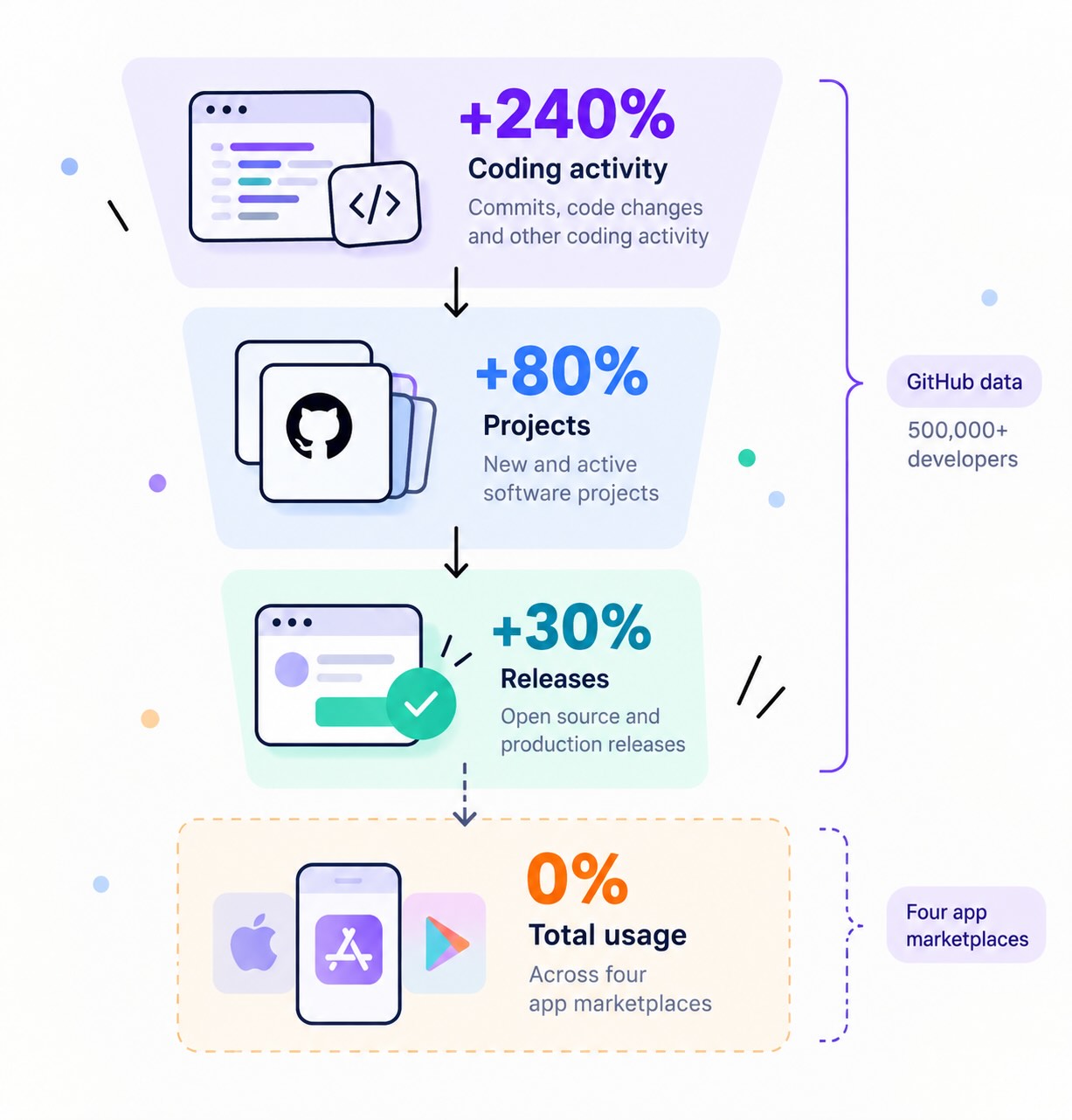
More software does not automatically mean more software gets used. Flat usage does not prove that the additional software was worse or less usable: the NBER data cannot tell us why usage stayed flat, and discovery is only one possible explanation. But it raises a broader product question: when teams can build and ship much faster, how do they know what they ship actually works for users?
That makes product and UX validation part of the equation. Faster implementation creates more opportunities to test, iterate and learn, but only if validation can keep pace with the development cycle. Synthetic users for UX testing are one approach to testing product flows earlier and more frequently as development cycles accelerate.
Where the gains get absorbed
If code generation accelerates and final output does not keep pace, the gain is being absorbed somewhere between the two. Several 2024–2026 datasets point to where.
Code review is becoming a measurable bottleneck
Faros AI's 2026 telemetry suggests that code review is becoming one of the places where increased AI output meets a human capacity constraint. The data covers 22,000 developers in more than 4,000 teams. Task throughput per developer rose 33.7%. Over the same period:
- median time in review rose 441.5%
- time to first review rose 156.6%
- pull requests merged without any review rose 31.3%
- bugs per developer rose 54%
- the ratio of incidents to pull requests rose 242.7%
Faros sells engineering analytics, so treat this as vendor telemetry rather than independent research. The figures also show changes over the same period, not proof that AI caused them. But the direction matches independent findings.
A longitudinal academic study of an enterprise that mandated doubling developer output, AI Writes Faster Than Humans Can Review, followed 802 developers and 196,212 pull requests. Output per developer reached 2.09 times the pre-mandate baseline. Per-reviewer load roughly doubled, and automated review overtook human review. Notably, merge and revert rates held steady, so the study did not observe a corresponding change in those quality-related indicators despite the extra volume.
As Musolff told Wharton, "If the same AI that wrote the code also reviews it, that doesn't really solve the problem."
Verification is taking up the time saved
A March 2026 DORA analysis found that "while AI successfully accelerates initial code generation and reduces the friction of starting new tasks, the time saved in creation is frequently re-allocated to auditing and verification."
One engineer quoted in the analysis put it plainly: "While I end up spending less time writing code, I spend more time babysitting the AI and reviewing what it is trying to do."
DORA's recommended countermeasure is working in small batches: forcing large AI-generated changes into "reviewable, testable units."
Delivery stability remains the weak point
Google's DORA research shows how this relationship has shifted over two years.
In the 2024 DORA report, a 25% increase in AI adoption was associated with an estimated 1.5% decrease in delivery throughput and a 7.2% decrease in delivery stability. DORA pointed to the basics AI does not fix on its own: "small batch sizes and robust testing mechanisms."
By the 2025 DORA report, based on nearly 5,000 technology professionals, throughput had turned positive: "Unlike last year, we observe a positive relationship between AI adoption on both software delivery throughput and product performance." Stability had not: "AI adoption does continue to have a negative relationship with software delivery stability."
In other words, DORA's data does not show one fixed relationship between AI adoption and delivery performance. Between the 2024 and 2025 reports, the throughput relationship reversed while the stability relationship stayed negative.
DORA's explanation is that AI acts as an amplifier: "AI accelerates software development, but that acceleration can expose weaknesses downstream." Without robust controls such as strong automated testing, mature version control and fast feedback loops, more change volume leads to instability. Teams in loosely coupled architectures with fast feedback loops see gains, while those "constrained by tightly coupled systems and slow processes see little or no benefit."
This is the weak-link effect again: accelerating code generation does not automatically accelerate the rest of the delivery system.
The gains depend on organizational redesign
McKinsey's August 2026 survey of 334 product and engineering professionals shows how uneven the results are:
- only 25% of respondents at director level and above report meaningful or top AI acceleration, which McKinsey defines as "more than a quarter of their teams achieving twofold or greater productivity gains"
- 30% report that team productivity has actually fallen
- around 80% of software engineers report an average acceleration of about 3%
- the top 20% of engineers report gains averaging 55%
McKinsey argues that what separates the leaders is "how effectively they tailor their end-to-end workflows, roles, control systems, and change management." That includes "building verification, control, and measurement systems that can keep pace with new and faster ways of working." In other words, the organizations seeing large gains have changed the rest of the chain, not just added AI coding tools.
These are self-reported survey figures, but they match the pattern in the measured data.
Other likely bottlenecks
Review, verification and delivery stability are the bottlenecks with the most data behind them. Others are plausible but have not been measured with the same rigor: deciding what to build, integrating changes, release and approval processes, security checks, and distribution. The NBER results suggest the answer differs by organization, but the principle holds: speeding up one step in a chain does not speed up the chain by the same amount.
What the research says in 2026
- AI dramatically increases coding activity. The effect is large, consistent and growing.
- Agentic tools produce much larger gains than autocomplete. Each tool generation has multiplied the effect of the last.
- The effect shrinks as you move toward finished software. Commits grow far more than projects, projects more than releases, and releases more than usage.
- The rest of the development system has to change too. Review capacity, testing, delivery stability and organizational process decide how much of the coding gain becomes shipped software.
- There is no credible universal "X times faster" number. Any figure depends on what is measured, on what kind of code, and over what period.
Frequently asked questions
How much faster is software development with AI in 2026?
It depends on what you measure. In the largest 2026 study, AI coding tools increased coding activity by up to 240%, but software releases by about 30%. Randomized experiments at the task level find gains of around 25%.
Does AI make developers faster?
For most coding tasks, yes. Field experiments with 4,867 developers found 26% more completed tasks. But one randomized trial found experienced developers working on mature codebases were 19% slower with early-2025 tools, while believing they were faster.
Why doesn't faster coding mean faster shipping?
Because code generation is only one step in producing software. Review, testing, integration, release processes and product decisions have not accelerated at the same rate, so they limit how much of the coding gain reaches finished software.
What is the weak-link effect in AI software development?
It is the idea that output is limited by the steps that cannot easily speed up. The NBER study finds that AI and human effort act as strong complements, so the slowest human steps still set the overall pace.
Do AI coding agents deliver more than autocomplete?
Yes. In the NBER data, coding activity rose 30% with autocomplete, 180% with interactive agents and 240% with autonomous agents. But the gains shrink on the way to finished software: the 240% increase in coding activity corresponds to a 30% increase in releases.
Is there a reliable "AI makes developers X times faster" number?
No. Published figures range from a 19% slowdown to more than a 200% increase in coding activity. They differ because they measure different things, such as tasks, commits or releases, on different kinds of code and over different time periods.